
Is It Time to Convert to an S-Corp? How Business Owners Can Save Thousands in Taxes
Armando Ramirez4 min read
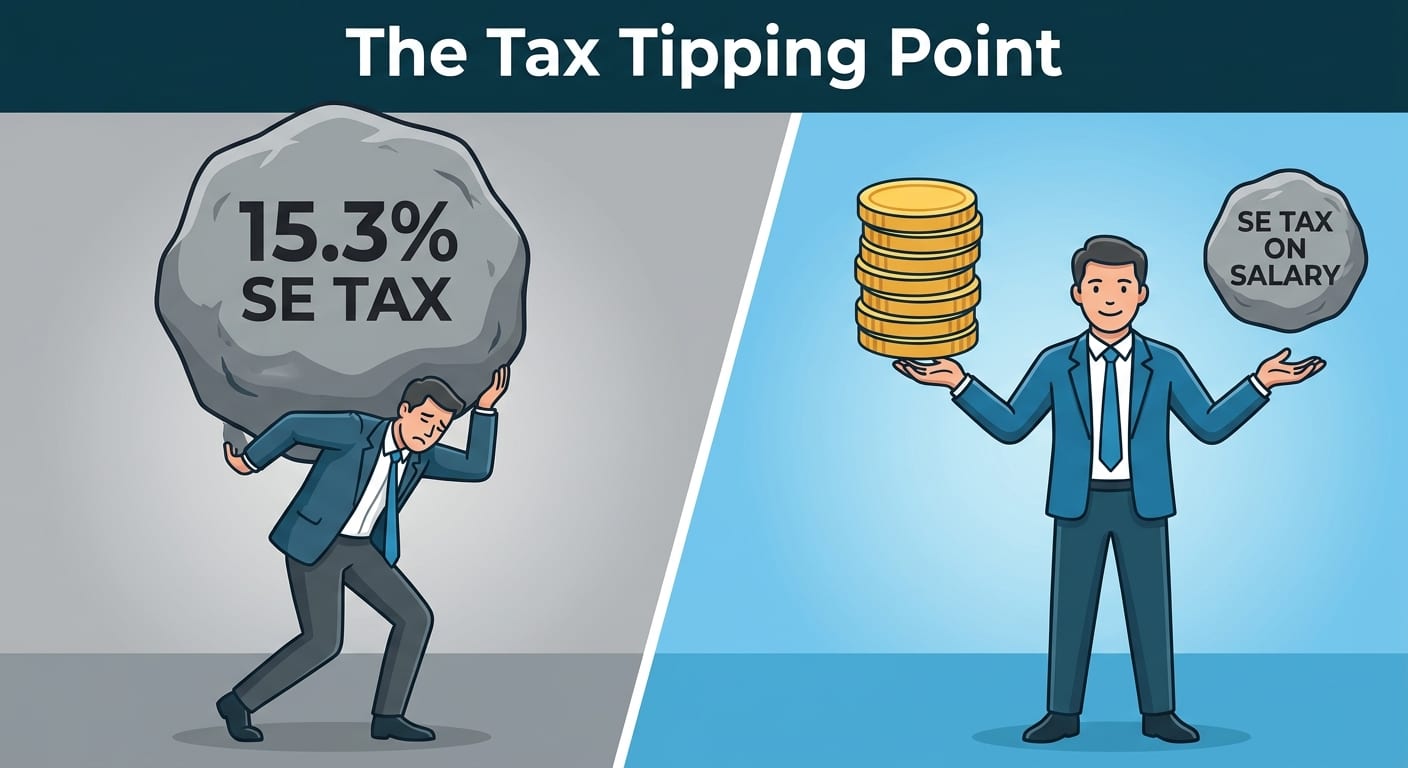
When you operate as a standard LLC or Sole Proprietorship, the IRS views 100% of your net profit as self-employment income. That means your net earnings are subject to the 15.3% Self-Employment Tax (12.4% for Social Security up to annual wage caps and 2.9% for Medicare).
Converting to an S-Corp allows you to split your business earnings into two categories:
- W-2 Salary: Subject to standard payroll taxes (FICA).
- Owner Distributions: Profit drawn from the business above your salary, which is not subject to self-employment tax.
IRS Rule: You are required to pay yourself a "Reasonable Salary" based on what it would cost to hire someone else to do your job in your market. You cannot pay yourself $0 in salary to avoid payroll taxes completely.
The same election has a side effect worth knowing if you also employ your own children: an S-Corp loses the FICA and FUTA exemptions that a sole proprietorship or single-member LLC gets on a minor child's wages. See which entity types keep that break and which ones don't.
When Does an S-Corp Conversion Make Sense?
While the tax savings sound appealing, operating as an S-Corp comes with additional overhead, including running formal W-2 payroll, filing a separate corporate tax return (Form 1120-S), and bookkeeping compliance.
As a general rule, an S-Corp conversion becomes worthwhile when:
- Net Profits Exceed 100,000 annually: Below this threshold, administrative and accounting costs often outweigh the tax savings.
- Profits are Steady: Your business generates predictable income rather than volatile, fluxing revenue month-to-month.
- You Can Support Payroll: You are ready to process regular W-2 payroll for yourself as an owner-employee.
An Example: The Tax Savings Breakdown
To see how the numbers work in practice, let's compare a business owner making $150,000 in net annual profit as a Sole Proprietorship/LLC versus electing S-Corp status.
In the S-Corp scenario, the owner sets a reasonable salary of $70,000 and takes the remaining $80,000 as distributions.
Net Profit: $150,000 for both options
W-2 Salary: $0 (Sole Prop / LLC) vs. $70,000 (S-Corp)
Owner Distributions: $150,000 (Sole Prop / LLC) vs. $80,000 (S-Corp)
Income Subject to Self-Employment / Payroll Tax: $150,000 (Sole Prop / LLC) vs. $70,000 (S-Corp)
Estimated Self-Employment / Payroll Taxes (15.3%): ~$21,186 (Sole Prop / LLC) vs. ~$10,710 (S-Corp)
Estimated Administrative & Payroll Costs: $0 (Sole Prop / LLC) vs. ~$2,000 (S-Corp)
Net Tax & Cost Benefit: By electing S-Corp status, the business owner achieves ~$8,476 in net savings after factoring in additional administrative costs.
Note: Calculations assume effective FICA/SE tax rates on eligible income before corporate expense adjustments. Actual savings vary based on state taxes, Qualified Business Income (QBI) deductions, and local filing requirements.
Next Steps for Your Business
Making an S-Corp election can unlock significant tax savings, but timing and execution matter. Form 2553 must be filed within 75 days of the start of the tax year (or by March 15 for existing businesses) to take effect for the current tax year.
If your net profits are approaching or exceeding $100,000, reach out to our team today to evaluate your numbers, determine a compliant reasonable salary, and handle your corporate tax elections smoothly.
Source