
Home Office Deduction 2026: How to Legally Write Off Your Apartment as a Business Expense
Armando Ramirez3 min read
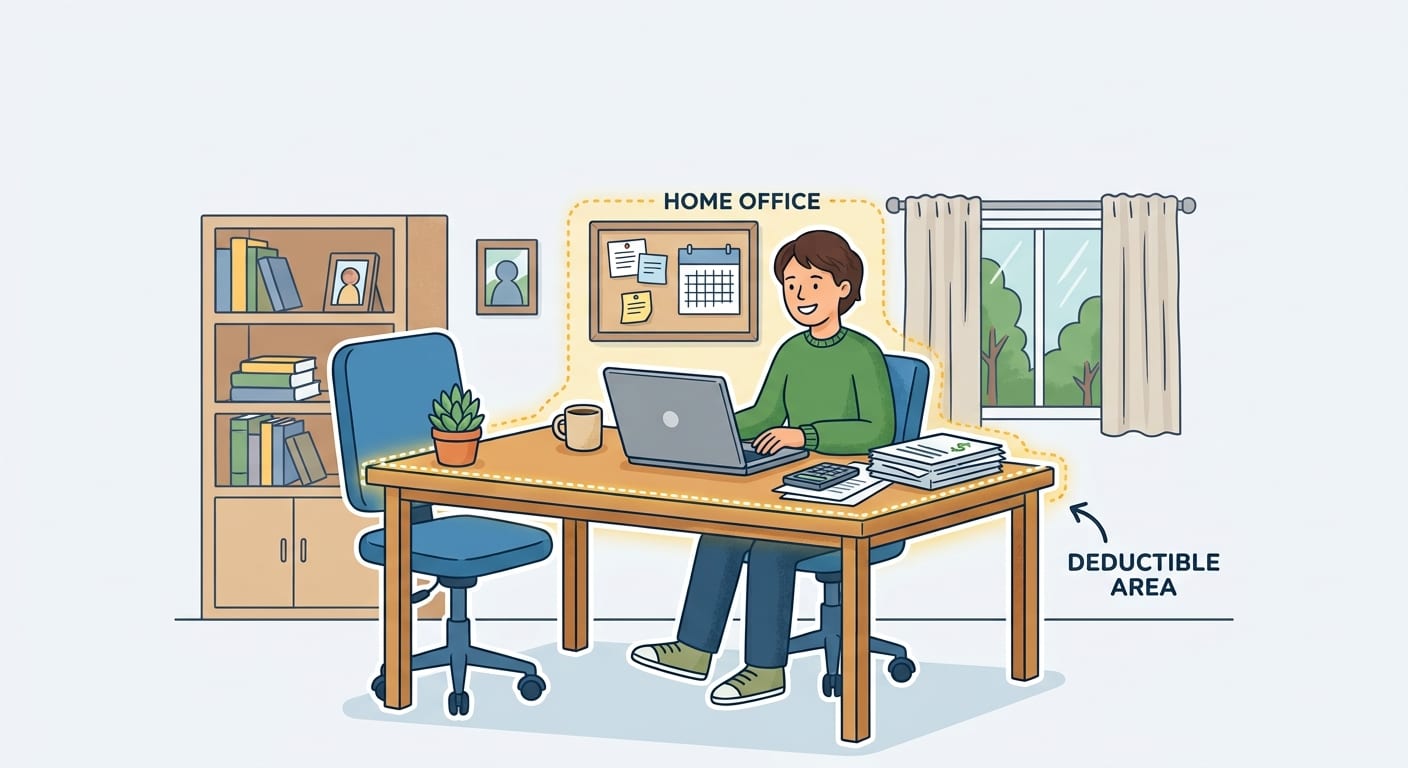
You’re running your business from a corner of your living room, a converted spare bedroom, or maybe just a desk crammed into your studio apartment. Every month you pay rent whether you use it for business or not, and here’s the part most new founders miss: a slice of that rent (and your utilities, internet, even your renters insurance) can become a legitimate home office tax deduction. This write-off isn’t some accountant’s secret handshake. It’s a real IRS provision, and if you’re self-employed or running an LLC, you’re probably leaving money on the table by not claiming it.
Who Qualifies for the Home Office Deduction
The IRS has two tests for the home office deduction, and both matter. Your space needs to be used regularly and exclusively for business, and it needs to be your principal place of business.
“Exclusively” is the word that trips people up. That desk in the corner of your bedroom where you also fold laundry and watch Netflix? Doesn’t count. But if you’ve designated a specific room, or even a clearly defined section of a room, used only for work, you’re in business. A closet converted into a workstation qualifies. A kitchen table where you eat breakfast and answer client emails does not.
You don’t need a separate room with a door, but you do need a defined space you can point to and say “this and only this is where I work.”
Simplified Method vs. Regular Method: How to Calculate Your Deduction
There’s a simplified method and a regular method for calculating your home office deduction, and picking the right one changes your outcome.
The simplified method lets you deduct $5 per square foot of your home office, up to 300 square feet. So if you’ve carved out a 150-square-foot room, that’s a straightforward $750 deduction. No receipts to track, no depreciation calculations. It’s fast, but it caps out quickly.
The regular method asks you to figure out what percentage of your home your office takes up, then apply that percentage to your actual housing expenses. Say your home office is 200 square feet and your apartment is 1,000 square feet total. That’s 20%. Now take 20% of your rent, your electric bill, your internet, your renters insurance, even a portion of repairs. If you pay $1,800 a month in rent, that 20% works out to $360 a month, or $4,320 a year, just from the office space itself. Add in utilities and internet, and the number climbs from there.
For most young entrepreneurs paying real rent in a real city, the regular method wins by a wide margin. The tradeoff is you need to keep records: lease agreements, utility bills, a rough measurement of your space.
Home Office Deduction for Renters vs. Homeowners
If you own your home, the regular method gets more complicated (and more powerful) because depreciation comes into play, letting you deduct a portion of your home’s value over time. Renters skip that complexity entirely since you’re not depreciating an asset you don’t own. That’s actually good news: renters get nearly all the benefit of this deduction with almost none of the paperwork headaches homeowners face when they eventually sell.
Other Deductible Home Office Expenses Beyond Rent
Once you qualify for a home office, that same percentage applies to other costs tied to running your home: internet service, phone lines used for business, even a portion of cleaning services if you have someone come through regularly. Founders often stop at rent and forget these secondary deductions exist, which means they’re capturing maybe half of what they’re entitled to.
Here’s a rough way to see how it stacks up. On a $2,000 monthly rent with a 15% office share:
- Rent portion: $300/month → $3,600/year
- Internet ($80/month): $12/month → $144/year
- Renters insurance ($20/month): $3/month → $36/year
That’s over $3,700 in deductions a year, just from a corner of your apartment you were already paying for.
Is the Home Office Deduction an Audit Risk?
A lot of young founders avoid the home office deduction because they’ve heard it’s an “audit flag.” That reputation is outdated. The IRS has simplified the process specifically because so many people qualify for it now, especially post-2020. As long as your space is genuinely dedicated to business use and you keep basic documentation (a photo of your setup, your lease, a few utility bills), you’re on solid ground.
The bigger risk isn’t claiming the home office deduction. It’s not claiming it, and quietly overpaying the IRS every single year for a home office you’re already sitting in right now.