
1031 Exchanges: How Deferring Taxes Today Builds Real Wealth Over Time
Armando Ramirez4 min read
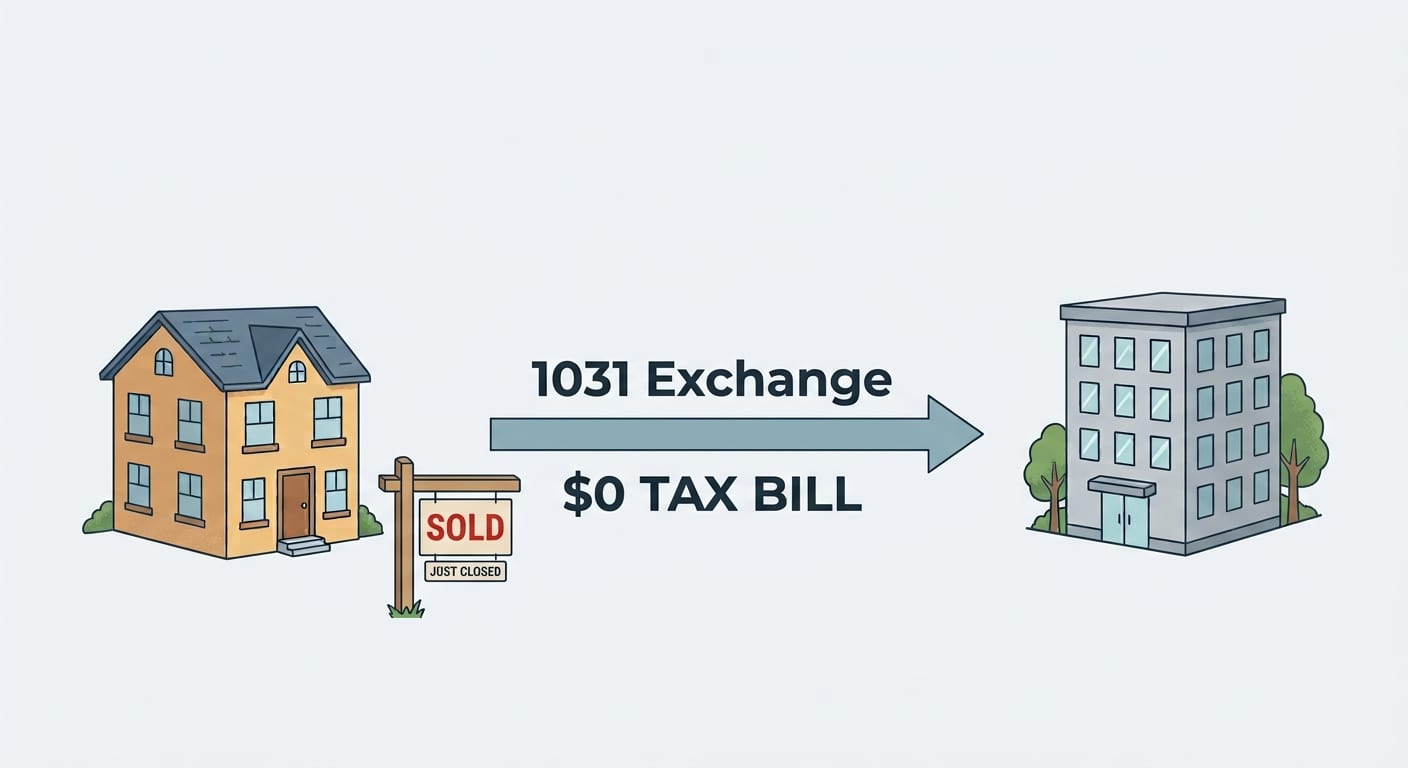
Most real estate investors know that selling an investment property means writing a check to the IRS. Fewer realize there’s a completely legal way to defer that check indefinitely, and fewer still understand just how much that deferral is worth in cold, hard dollars. The tool is Section 1031 of the tax code, and its power isn’t really about avoiding taxes. It’s about controlling when you pay them, which turns out to be one of the most underrated levers in real estate investing.
What a 1031 Exchange Actually Does
A 1031 exchange lets you sell an investment or business property and roll the proceeds into a new “like-kind” property without recognizing the capital gain at the time of sale. You’re not escaping taxation forever in a legal sense. If you eventually sell without doing another exchange, the deferred gain comes due. But in practice, many investors keep exchanging property after property for decades, and when they die, their heirs get a stepped-up basis that can wipe out the deferred gain entirely. That’s the often-cited “swap till you drop” strategy.
The mechanics have real teeth: you have 45 days after closing the sale to identify replacement properties, and 180 days total to close on one of them. You also need a qualified intermediary to hold the funds. You can never touch the cash yourself, or the exchange is disqualified.
Why Deferral Beats Avoidance in Investors’ Minds
It’s tempting to think of a 1031 exchange as “saving” the tax, but that’s not quite right. You’re postponing it. The real benefit is what you do with the money in the meantime. Money you don’t send to the IRS today is money that keeps working for you, compounding, generating rental income, or funding a bigger acquisition. That’s the time value of money at work, and it’s the actual engine behind why 1031 exchanges build wealth faster than the alternative.
The Numbers, Side by Side
Say an investor sells an apartment building for $2,000,000, with $800,000 of that being taxable gain (a mix of appreciation and depreciation recapture). Combined federal capital gains and depreciation recapture taxes might run around 30% for a high-income investor in a high-tax state, roughly $240,000 owed to the IRS at sale.
| Sell and pay tax | 1031 exchange | |
|---|---|---|
| Sale proceeds | $2,000,000 | $2,000,000 |
| Tax paid at closing | $240,000 | $0 |
| Capital reinvested | $1,760,000 | $2,000,000 |
| Value after 10 yrs at 6%/yr | $3,152,000 | $3,582,000 |
That $240,000 difference in starting capital, left to compound at a conservative 6% annually, grows to nearly $430,000 in value over a decade. The investor who exchanged didn’t dodge the IRS forever. They simply put the government’s share to work for ten years before it came due, and kept the growth it produced.
Watching the Gap Widen Year by Year
The table above shows the endpoint, but the gap doesn’t appear all at once. It opens gradually, then accelerates:
- Year 1: Exchanger’s extra capital ($240,000) has grown to about $254,000
- Year 3: Grown to about $286,000
- Year 5: Grown to about $321,000
- Year 10: Grown to about $430,000
That’s compounding doing what it does best. It’s slow at first, then increasingly hard to ignore.
It’s Not Just About the Math
Beyond the pure time-value argument, 1031 exchanges let investors reposition their portfolios without a tax penalty acting as a wall. An investor who bought a small multifamily property in 2005 and watched it appreciate might want to trade up into a larger, more efficient asset, move into a different market, or shift from active management into a passive structure like a Delaware Statutory Trust. Without a 1031, every one of those moves triggers a tax event that shrinks the capital available for the next deal. With one, the full value of the equity keeps moving forward.
The Catch Worth Knowing
None of this is a free lunch. The rules are strict and unforgiving. Miss the 45-day identification window by a single day and the entire exchange collapses, with the full tax bill due. The replacement property has to be equal or greater in value and debt to fully defer the gain, and the paperwork requires precision most investors don’t want to handle alone. This is a strategy that rewards working with a qualified intermediary and a CPA who does these regularly, not one to improvise.
The Takeaway
A 1031 exchange isn’t a tax dodge. It’s a decision to let your capital keep compounding instead of handing a chunk of it over early. The dollar amount of the tax you defer matters less than what that dollar amount becomes over the years you keep it invested. For investors thinking in decades rather than single transactions, that difference compounds into real, measurable wealth.